Why We Do Hard Things
Living Outside The Comfort Zone

Sunday evening I sat at my desk crying.
It may have been more accurately described as sobbing.
I was at a breaking point.
School felt like too much.
Three summer classes.
Most weeks there are hundreds of pages of reading. Multiple assignments due. Juggling group projects with teams of busy individuals to coordinate with. Weekly quizzes, essays, discussion board posts, a research paper, case studies, and group projects.
A classmate created a spreadsheet to organize all the assignments for the three classes. For the 15-week summer term, I have close to 90 tasks and assignments on the spreadsheet.
What happened Sunday evening was perhaps a genuine panic attack.
I have them very infrequently. Maybe only four in my lifetime.
If you have had one, you know how debilitating it can be.
I experience it very physically.
My body becomes numb. It feels as if my legs are no longer attached to my trunk. My face feels much the same, like the skin has slid down into my chest. The non-stop high-pitched shrill in my ears that I already experience from a chronic autoimmune disease escalates to a near-intolerable pitch. My vision goes blurry.
Then the sudden uncontrollable, hot tears.
Breathe... This is all I know how to do when this happens. Just breathe.
After... Pure exhaustion.
Completely wrung out.
I dropped down onto the daybed in my workspace.
Why am I doing this?
What am I trying to prove?
I don’t want to do hard things anymore!
Hadn’t I made this very vow to myself several years ago?
A promise to live a quieter, softer, slower life?
As my family and I were healing from major traumatic events, my mind, body, heart, and soul begged for an existence that didn’t require me to do hard things.
Yet here I sat, mentally and physically wrung out in that moment.
I had just spent hours pushing myself through an assignment that challenged the limits of my brain, so changed by seizure activity that I had started the looping thinking of:
I can’t do this. This is impossible. I am simply not smart enough to figure this out.
My brain doesn’t work the way it once did.
The words on the screen started to blur and, well, the panic attack happened.
A bit of time on the daybed did me good.
This is where I am so grateful for the practice of mindfulness.
Breathing.
Gentle awareness.
Compassion. Thank goodness for compassion.
The harsh judgment of my inner critic quieted, and from a more loving place, I was able to ask myself, “Why am I doing this?”
Yes, this is a hard thing I have chosen to do.
Going back to school at 53 was never going to be easy.
But I had realized at some point neither was staying in the comfort zone.
For a while, though, that was essential. Resting in the comfort zone.
In the aftermath of life’s devastating events, it was necessary to conserve energy. I needed what was safe and predictable to soothe my nervous system so that healing could begin. The comfort zone was a much-needed balm.
Healing lived there.
Rest lived there.
Safety lived there.
But I could only stay there so long.
There was a season I needed safety.
Now I need aliveness.
New energy and trust in life emerged over time.
Little by little, I could feel life bubbling back up inside me again, asking me to create something new.
There was no denying that.
I was apprehensive initially.
I remember the resistance so clearly.
I could feel the energy swirling inside me while my mental defenses argued against it.
There was a real tug-of-war between safety and discomfort.
Between healing and hiding.
And eventually I realized those were not the same thing.
For a long time, I genuinely believed I was done doing hard things.
What I eventually came to understand was that I wasn’t avoiding challenge.
I was healing.
And healing and hiding are not the same thing.
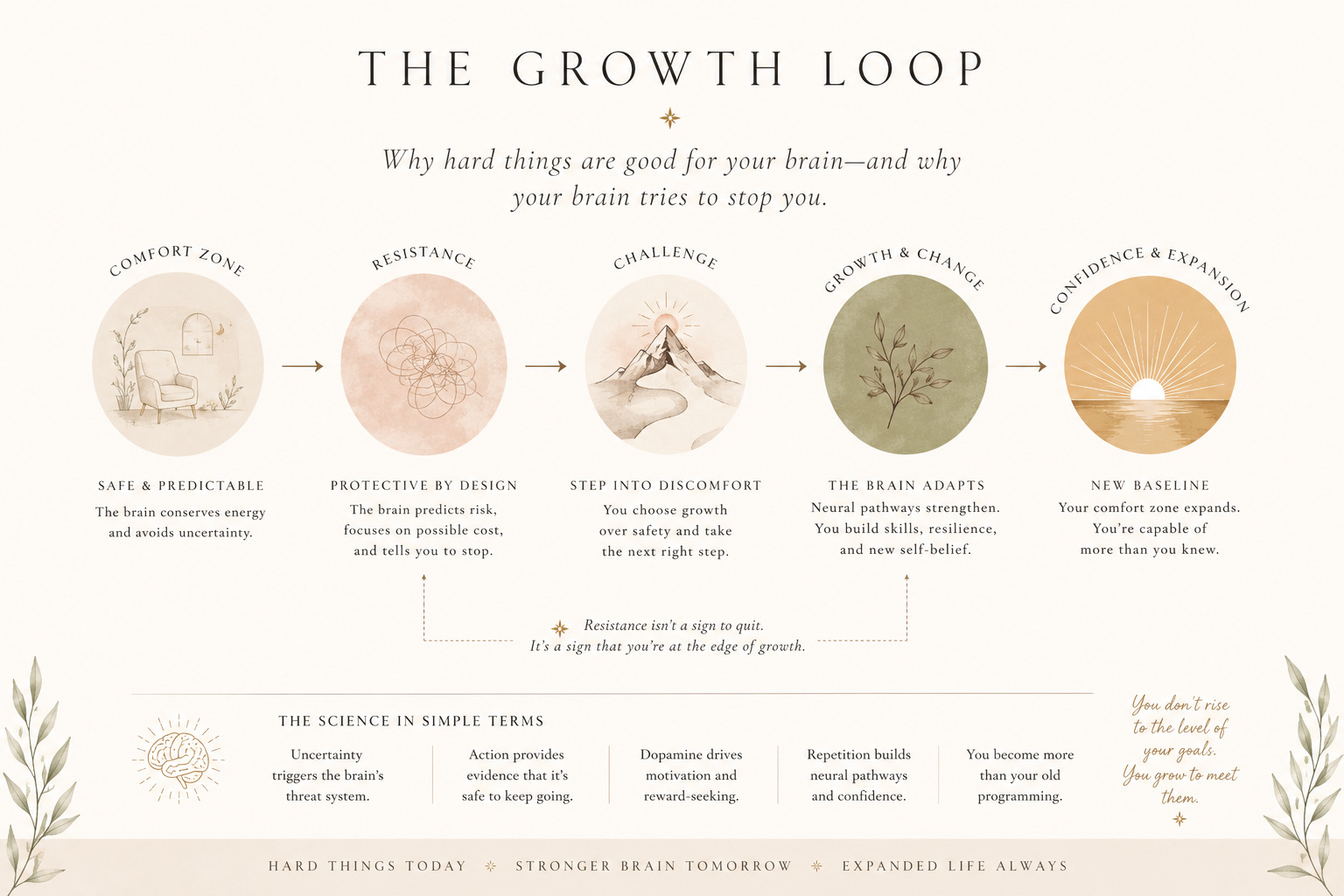
Resistance isn’t a sign to quit, though.
Sometimes it is simply evidence that we are standing at the edge of something important.
This is often where we develop courage and resilience.
As I took those steps to begin living outside my comfort zone again, following the natural instinct to live that nudged me forward, my brain adapted.
There is all sorts of science here that I am woefully unqualified to explain, but what we do know is that as we take small steps, building new skills and having new experiences, the neural pathways of the brain strengthen.
What once felt impossible slowly becomes manageable.
We gather evidence that we can do hard things.
Confidence grows.
Resilience grows.
New self-beliefs emerge.
Little by little, our comfort zone expands.
Not because life becomes easier. Because we become more capable.
We realize that challenge can feel good. Energizing. There is a vitality to it.
This is how change happens.
Looking back now, I can also see how I arrived at that moment on Sunday evening.
Three summer classes. Too many hours sitting at a computer. Not enough movement. Not enough time outside. Not enough spaciousness between one task and the next.
The very things I know help me stay grounded had slowly started to slip as the demands of the semester increased.
The panic attack wasn’t a sign that I couldn’t do this.
It was a reminder that I cannot abandon myself in pursuit of a dream.
That may be one of the most important lessons of all.
The goal isn’t to do hard things at any cost. The goal is to remain connected to ourselves while we do them.
I didn’t return to school because I have forgotten what was important to me.
I returned because for decades, becoming a mental health counselor lived in my heart as a dream.
Eventually, the discomfort of not answering that call became greater than the discomfort of answering it.
Why do we do hard things?
Not to prove our worth.
Not to earn our place.
Not because struggle is noble.
We do hard things because life continues to invite us into our fullness.
And sometimes the most beautiful dreams we carry require us to grow into the person capable of living them.
An Invitation
What hard thing has life been asking of you lately?
Where is the difference between healing and hiding showing up in your own life?
What dream might be waiting for you on the other side of your comfort zone?
What self-care practice helps keep you grounded when life feels overwhelming?
I would love to hear from you in the comments below or via a private message.
Thanks for supporting my Substack. Be sure to subscribe or consider a pledge! AND Please restack or forward to a friend. THANKS!

Great teaching, reflection, Keri. I try to get out in nature to forest bathe. I focus on trees, their leaves. I try to get out of myself.